Why Your A/C Capacitor Fails During the First Fall Heating Startup
Smelling burning dust on the first cold night? Review these home maintenance tips and troubleshooting facts to decide when to call a pro for fall heating.


When the first cool front of the season finally arrives, you might experience The September Humidity Trap: Why Your House Feels Clammy When the Temperature Finally Drops. The outdoor thermometer shows a welcome decline, giving you a sense of false hope that relief has arrived. You expect your home to feel crisp, refreshing, and comfortable. Instead, you walk inside and the indoor air suddenly feels sticky, damp, and overwhelmingly heavy. Here at Climate Tamers, our team receives calls every early fall from homeowners facing this highly specific, concrete problem: their central cooling equipment stops running long enough to remove moisture because the sensible heat has dropped. You are now faced with a frustrating decision point. Do you choose the temporary, uncomfortable fix of overcooling the house just to force the system to run, or do you address the root cause with dedicated moisture control?
To fully understand how to manage this seasonal shift, we find it helps to look closely at how your air conditioning system interacts with the unique weather patterns of the Gulf South.
Most homeowners assume that the number on the thermostat is the only metric that matters for indoor comfort. However, human comfort is actually dictated by a delicate balance between temperature and relative humidity. When these two factors fall out of alignment, our customers often describe experiencing the dreaded clammy house phenomenon.
To understand why a room can feel terrible even when the thermostat reads a perfectly normal 72 degrees, you have to understand how your body cools itself. Your skin relies on the evaporation of sweat to release body heat. When the indoor air is loaded with heavy moisture, that evaporation process slows to a halt. The sweat stays on your skin, making the air feel sticky, stagnant, and much warmer than the thermometer indicates. You are feeling the physical mismatch between a cool room and saturated air.
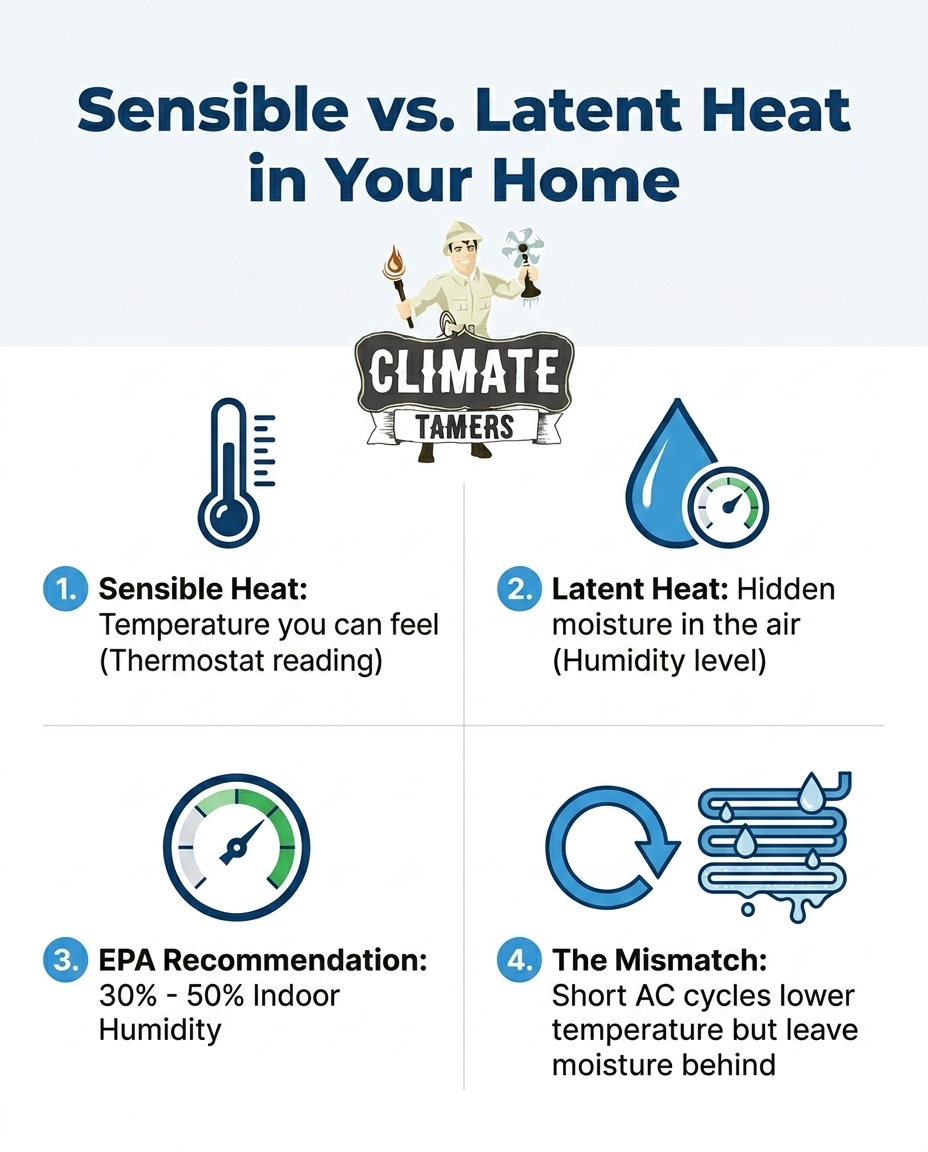
Maintaining the right moisture levels is about more than just feeling comfortable; it is essential for the health of your home. The Environmental Protection Agency (EPA) recommends keeping indoor humidity between 30 and 50 percent. Staying within this range prevents mold growth, discourages dust mites, and protects your woodwork and furnishings.
When your home frequently exceeds that 50 percent threshold, our experts recommend comprehensive indoor air quality solutions to bring the environment back into balance. Here is a quick look at how different humidity levels affect your home:
• Below 30% — Sensory Experience: Dry skin, static electricity — Impact on the Home Environment: Wood floors may shrink or gap
• 30% to 50% — Sensory Experience: Crisp, dry, and comfortable — Impact on the Home Environment: Ideal conditions recommended by the EPA
• 55% to 65% — Sensory Experience: Slightly sticky, heavy air — Impact on the Home Environment: Musty odors begin to develop
• Above 65% — Sensory Experience: Cold and clammy, sweating indoors — Impact on the Home Environment: High risk for mold and mildew growth
If you live in Greater New Orleans and Metairie, you are likely familiar with that heavy, over-65-percent feeling. In our years of servicing local homes, we've learned that resolving it requires looking past the thermostat and understanding how your equipment actually handles moisture.
To understand why your home feels so damp during the early fall / September shoulder season, we often walk our clients through the two different types of heat their system battles every day. Bypassing the basic definitions of an air conditioner, let's dive into the physics of how heat and moisture interact inside your living space.
Sensible heat is exactly what it sounds like: the heat you can sense and measure with a standard thermometer. When you turn on your oven or open a window on a sunny day, you are introducing sensible heat into the room. Your thermostat only reads sensible heat. When it detects that the sensible heat has reached your desired setpoint, it sends a signal to shut the cooling cycle off.
Latent heat is the thermal energy hidden within the moisture in the air. You cannot measure latent heat with a standard thermometer; you need a hygrometer to measure the relative humidity. Latent heat is what makes a 90-degree day in the swamp feel suffocating, while a 90-degree day in the desert feels entirely manageable.
Standard cooling systems are designed primarily to lower sensible heat. They remove latent heat (moisture) only as a byproduct of the cooling process. Here is how our technicians explain that byproduct effect:
• The cold coil: Warm, humid indoor air is pulled through your return vents and blown across the freezing cold evaporator coils inside your indoor unit.
• The condensation effect: Just like water droplets forming on the outside of a cold glass of iced tea on a summer afternoon, the moisture in the air condenses onto the cold metal coils.
• The drainage: Those water droplets drip down into a drain pan and are safely routed outside your home.
• The requirement for time: For this process to work, the air must pass over those cold coils for extended periods.
The fundamental physics are clear: without long, uninterrupted run times, the condensation process never gets a chance to pull enough water out of the air. The temperature drops, the system shuts off, and the latent heat remains trapped indoors.
The physics of sensible and latent heat explain the mechanics, but the actual cause of your clammy house is a distinct regional climate quirk that our team at Climate Tamers battles every day. Living in Greater New Orleans and Metairie means dealing with weather patterns that most standard HVAC systems were not strictly designed to handle.
During the peak of summer, your cooling system runs constantly. The outdoor temperatures are scorching, meaning the sensible heat load on your home is massive. Because the system runs for hours at a time to combat that sensible heat, it has plenty of time to condense and drain away the latent heat (humidity). The result is a cool, dry house.
As we enter the Greater New Orleans September reality, the weather shifts. The outdoor temperatures begin to dip slightly from their summer peaks. You might see highs in the low 80s instead of the upper 90s. This reduces the sensible heat load on your home significantly. However, the ambient humidity frequently remains extreme, often sitting above 75 percent outdoors.
Because the home cools down much faster, your thermostat quickly registers that the sensible heat goal has been met. It shuts the system off rapidly—a process known as short-cycling—long before the equipment has time to extract the heavy moisture from the air. The system is doing exactly what it was programmed to do: satisfy the temperature setpoint. This is a regional climate mismatch, not necessarily a mechanical failure—a pattern we see constantly during early fall tune-ups.
Understanding this dynamic is the first step toward improving indoor air quality in the Big Easy. You cannot force a standard air conditioner to ignore the thermostat reading, which leads many homeowners to try and trick the system.
When we visit homes in Metairie, the most common homeowner reaction we see when a house feels damp is to walk over to the thermostat and drop the temperature. If 72 degrees feels clammy, you might push it down to 68 degrees just to force the system to turn on, get the air moving, and clear out the dampness.
This instinct makes sense on the surface, but we constantly remind our clients that it creates a massive negative tradeoff. You end up freezing out the house, wasting significant amounts of energy, and putting unnecessary wear and tear on your equipment during the early fall / September shoulder season.
Lowering the thermostat only provides temporary relief. Here is what we observe when homeowners try to overcool their way out of a humidity problem:
• The initial blast: The system kicks on, the air circulates, and the house temporarily feels less stuffy.
• The rapid satisfaction: Because the outdoor temperatures are already mild, the house reaches 68 degrees very quickly.
• The quick shutdown: The system turns off again before it can extract meaningful amounts of moisture.
• The freezing aftermath: You are now sitting in a house that is 68 degrees with 65 percent humidity, which feels like a damp, freezing cave. The clammy feeling quickly returns, just at a lower temperature.
Another common mistake we advise against is switching the thermostat fan setting from "AUTO" to "ON." Homeowners often think that keeping the fan running constantly will help dry out the air. In reality, it does the exact opposite. When the cooling cycle ends, the evaporator coil is still dripping wet with the moisture it just pulled from the air. If you leave the fan running, it blows right across that wet coil, evaporating the water and sending the latent heat straight back into your living room.
If overcooling the house is a waste of energy and leaving the fan on makes the problem worse, how do you solve the September humidity trap? In our experience, the answer is separating the sensible heat control from the latent heat control.
Whole-home dehumidifiers are dedicated systems designed specifically to handle latent heat independently of sensible heat. Unlike standard cooling equipment, a dehumidifier operates based on the readings from a hygrometer, not a thermometer. When the humidity in your home rises above your desired setpoint (for example, 45 percent), the dehumidifier activates, regardless of whether the air conditioner is running.
Unlike portable units that you have to drag from room to room and empty by hand, a whole-home system integrates directly with your existing ductwork. It pulls moisture from every room in the house simultaneously. The collected water is routed directly into your main condensate drain, meaning you never have to empty a bucket.
The comfort benefits we see after installation are immediate and dramatic. When you remove the heavy moisture from the air, a 74-degree home feels perfectly crisp, dry, and comfortable. You save money on your utility bills because you no longer have to push the thermostat down to 68 degrees just to feel comfortable. Additionally, federal tax credits or utility incentive programs may apply to qualifying high-efficiency heat pump and indoor air quality installations, so we always advise our clients to verify current programs with their utility or a tax professional.
As local experts, our team at Climate Tamers provides tailored indoor air quality solutions designed specifically for Louisiana falls, rather than just pushing standard cooling repairs for a climate issue. We understand the specific challenges of living in Greater New Orleans and Metairie, and we know that addressing the root cause of the regional climate mismatch is the only way to achieve true indoor comfort.
While shoulder season clamminess is very often a climate quirk caused by short-cycling, our service technicians know that high humidity can sometimes mask real equipment issues. If your system is actually broken, a dehumidifier will not fix the underlying mechanical failure.
You need to know the difference between a system that is struggling with the early fall / September shoulder season weather and a system that is actively malfunctioning. Here are a few signs our team looks for to determine if your clammy house is the result of a breakdown rather than a climate mismatch:
• Frozen evaporator coils: If you see ice building up on the indoor unit or the copper refrigerant lines, your system has an airflow restriction or a refrigerant leak. It cannot remove moisture or cool the air properly in this state.
• Clogged condensate drains: If water is pooling around the indoor unit or the drain pan is overflowing, the system is successfully pulling moisture from the air, but it cannot get rid of it. This water often evaporates back into the home.
• Constant running without cooling: If the system runs for hours on end but the temperature never drops and the air feels warm and sticky, you likely have a mechanical failure.
• Unresponsive controls: Sometimes the issue lies entirely with the communication between the wall and the unit. For example, our dispatch recently received a call on a Sunday afternoon during a holiday weekend when a local system stopped responding entirely. A Climate Tamers technician arrived shortly after the call and resolved the underlying thermostat issue, restoring proper operation and allowing the system to manage the indoor climate again.
Staying on top of routine HVAC maintenance ensures that your system is functioning at peak efficiency to handle whatever moisture it can. When our crews respond to same-day service calls in the fall, we often reveal simple fixes—like a clogged filter or a dirty coil—that restore proper airflow and moisture removal capabilities.
Your house feels damp because the outdoor temperatures drop, causing your air conditioner to run for shorter periods. While the temperature inside cools quickly, the short run times prevent the system from extracting the high ambient humidity from the air. This leaves the latent heat trapped inside, creating a sticky, damp feeling.
Our experts note that the most effective way to remove humidity without lowering the temperature is by using a dedicated whole-home dehumidifier. These systems operate independently of your cooling equipment, pulling moisture out of the air based on humidity levels rather than temperature. Ensuring your home is properly sealed against outdoor air infiltration also helps significantly.
If your system is running but the house remains humid, it may be oversized for your home, causing it to short-cycle and shut off before dehumidification occurs. Alternatively, you could have a frozen evaporator coil, a clogged condensate drain, or a refrigerant leak. We recommend a professional inspection to determine if it is a sizing issue or a mechanical failure.
A clammy feeling is caused by a mismatch between sensible heat (temperature) and latent heat (moisture). When the air is cool but highly saturated with water vapor, your sweat cannot evaporate off your skin. This combination of low temperature and high relative humidity produces the cold, sticky sensation known as clamminess.
We always recommend leaving your thermostat fan set to 'AUTO' if you want to control humidity. Setting the fan to 'ON' forces it to run continuously, which blows air over the wet evaporator coil after the cooling cycle ends. This evaporates the water sitting on the coil and pushes the moisture right back into your living space.
Yes, in our experience, a whole-house dehumidifier is vastly superior for shoulder seasons. It integrates directly with your ductwork to manage the moisture levels in every room simultaneously, rather than just treating a single isolated space. It also drains automatically, eliminating the daily chore of emptying heavy water buckets associated with portable units.
You don't have to spend every early fall choosing between a freezing living room and a clammy, sticky house. By understanding the regional climate mismatch and exploring dedicated moisture control options, you can achieve true indoor comfort. Schedule a system evaluation with the Climate Tamers team today to find the exact whole-home solution that fits your needs.

Our customers consistently praise Climate Tamers for our professionalism, fast service, and commitment to keeping their homes comfortable.