Why Your A/C Capacitor Fails During the First Fall Heating Startup
Smelling burning dust on the first cold night? Review these home maintenance tips and troubleshooting facts to decide when to call a pro for fall heating.


Just as the kids are heading back to school and you're hoping for an end-of-season cooling break, the temperature inside is climbing steadily, your vents are blowing nothing but warm air, and there is a strange, continuous noise coming from the side of your house. Your AC is running nonstop, but the house still feels incredibly warm. At Climate Tamers, we field countless calls about this exact issue. If you are wondering what actually happens when a Metairie heat wave fries your AC capacitor, you are certainly not alone. During a relentless Louisiana August heat wave, our team finds that this specific mechanical breakdown is one of the most frequent reasons homeowners suddenly lose their indoor cooling.
If you need immediate help, learn more about your HVAC system or schedule air conditioning repair right away.
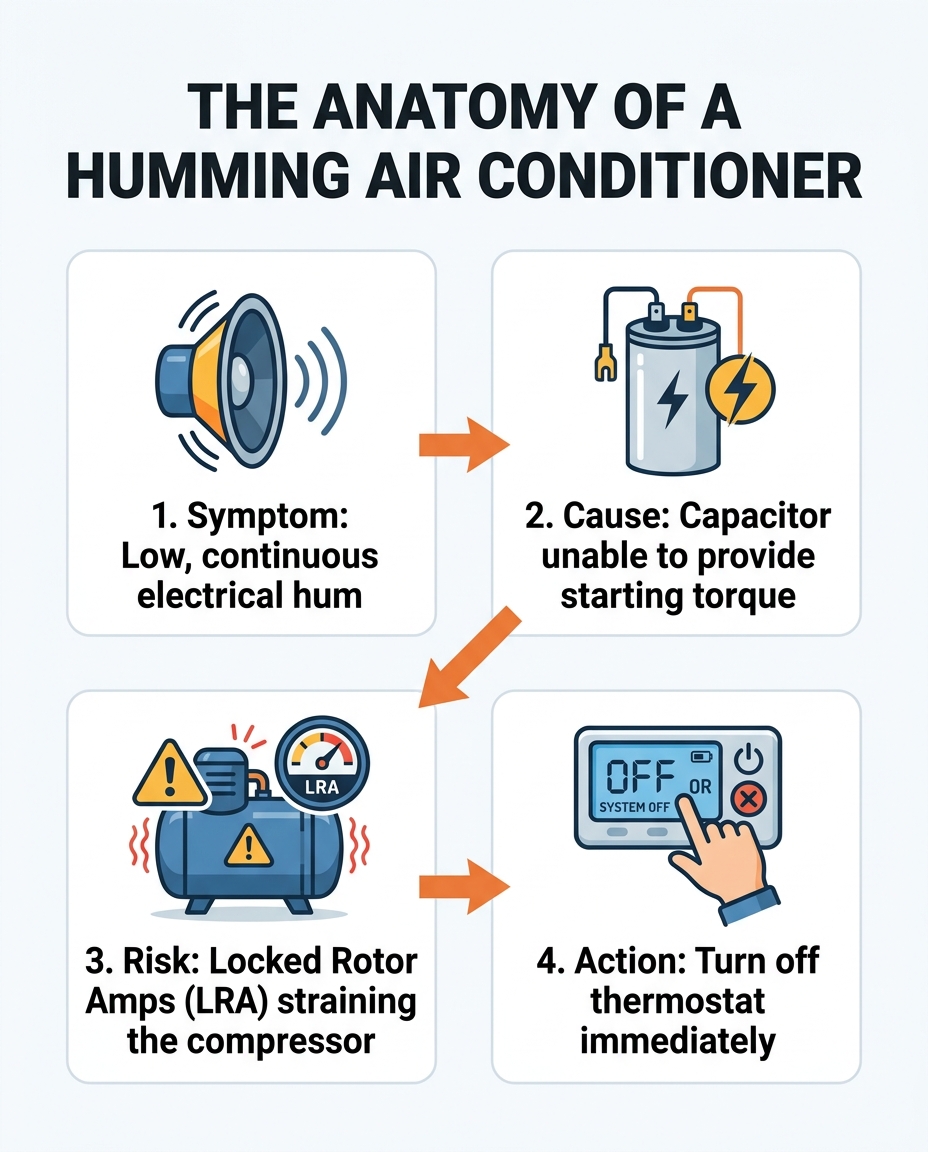
The immediate discomfort of losing cool air during late summer is stressful enough, but the auditory clues your system provides are what truly matter in this moment. Typically, the outdoor unit will make a distinct, low-pitched humming or buzzing noise, yet the fan blades at the top of the cabinet remain completely stationary. Many homeowners hear this ominous sound and immediately panic, assuming the entire air conditioning system has suffered a catastrophic death.
However, this specific scenario usually points to a highly common electrical failure rather than a complete system loss. When you find your system humming but not starting, you are dealing with an electrical bottleneck. Understanding exactly what this distinct sound means is the key to preventing a relatively minor component failure from destroying the most expensive and vital parts of your cooling equipment.
To understand why your air conditioner is making that noise, our technicians often find it helps to look at the mechanical reasons behind the failure without getting bogged down in overly technical engineering jargon. The problem begins with the initial power demand required to start the system.
Air conditioners require a massive initial jolt of energy to start their heavy-duty motors—far more power than your home's standard electrical wiring can provide in a single instant. The dual run capacitor acts much like a powerful battery or a jump-starter for your car. It stores electricity and releases it in a concentrated burst to get the compressor and the condenser fan spinning. It sends energy to both of these critical components simultaneously. When this small but vital part fails, these heavy-duty components are left completely stranded without the starting torque they desperately need to begin their cycles.
When the capacitor dies, the compressor and fan still receive the signal from your indoor thermostat to turn on. They attempt to draw power to start, creating a condition that HVAC professionals refer to as "locked rotor amps" (LRA). Because the motors absolutely cannot turn without that initial electrical jump-start, the electrical current simply strains against the stationary machinery.
That ominous humming noise you hear outside is quite literally the sound of electrical energy trapped in a motor that cannot rotate. Contrasting this specific humming sound with other common operational noises can help you accurately identify the problem. For example, a rattling sound might just be a loose cabinet panel, and a screeching noise might indicate a failing fan motor bearing. However, a steady electrical hum with zero fan movement is the classic hallmark of a dead capacitor. This is very different from the sounds you might hear from a heat pump making noise during a normal defrost cycle or due to standard compressor wear.
Why do these electrical components seem to fail all at once during the late summer months? In our years of servicing Metairie neighborhoods, we've seen that the answer lies directly in the unique environmental stress of our region. Capacitors are essentially small metal cylinders filled with a specialized dielectric fluid and layers of conductive foil. Over time, this internal fluid degrades naturally, but sustained high thermal loads drastically accelerate this exact breakdown process.
In our area, the ambient temperature is only half of the battle. Metairie's extreme humidity indexes force air conditioners to run almost continuously just to remove latent heat from the indoor air. This relentless dehumidification process means your outdoor unit rarely gets a break. Those extended, continuous run cycles completely eliminate the natural off-cycle cooling periods that outdoor electrical components desperately need to shed their accumulated heat.
When the ambient air temperature outside is hovering near 100 degrees during a Louisiana August heat wave, the internal temperature of the metal condenser cabinet is significantly hotter. The capacitor literally bakes inside the unit while constantly storing and releasing high-voltage charges. As the dielectric fluid breaks down and loses its ability to hold a charge, the top of the metal cylinder will often bulge or swell outward.
• Normal Spring/Early Summer Weather — Impact on Electrical Components: Standard run times allow components ample time to cool off between cycles.
• High Humidity (Metairie Climate) — Impact on Electrical Components: Continuous dehumidification cycles severely limit necessary off-cycle cooling periods.
• Relentless August Heat Wave — Impact on Electrical Components: Maximum thermal stress causes rapid degradation of dielectric fluid and component failure.
The cumulative stress of an intense late-summer season pushes aging, thermally stressed capacitors right past their breaking point, resulting in the dreaded hum.
If you walk outside and find your system humming but not starting, you are immediately on the clock. This is not a situation where you can let the system run and hope it eventually kicks on. You must take immediate action to protect the core of your cooling equipment from irreversible damage.
1. Turn off the thermostat immediately: Do not wait to see if the system recovers. Switch your indoor thermostat from "cool" to the "off" position. This stops the unit from trying to draw power.
2. Locate your electrical breaker: For added safety, find your home's electrical panel and flip the dedicated breaker for your AC unit to the "off" position.
3. Call for professional diagnostic help: Reach out to a licensed technician who can safely test the high-voltage electrical components and restore power.
The danger of leaving a humming system turned on is incredibly severe. The compressor will continue pulling locked rotor amps, causing its internal electrical windings to overheat rapidly. Eventually, the compressor will literally burn itself out from the continuous electrical strain. The massive difference in scope between replacing a simple electrical component versus replacing a burned-out, completely dead compressor cannot be overstated.
Acting quickly preserves the core of your cooling equipment. Our technicians at Climate Tamers see this exact pattern frequently in our area. Recently, one local customer reached out during the late-summer back-to-school transition when they experienced a difficult power issue with their AC unit that was not an easy fix for a homeowner to diagnose. Because they shut the system down when it began struggling, our technician was able to get the AC back in working order simply by replacing the faulty capacitor. The unit was safely diagnosed and repaired in minutes, completely saving the compressor from permanent damage.
It can be tempting to look up a quick internet tutorial when you realize how small a capacitor actually is, but we always warn homeowners that this is one repair that strictly requires professional residential HVAC services. The dangers associated with high-voltage HVAC components are severe, and handling them without proper training is incredibly risky.
First and foremost, capacitors are designed to store massive amounts of electrical charge. Even after the power to the unit has been completely disconnected at the main breaker, a capacitor can still hold a lethal electrical charge for a significant amount of time. Touching the wrong terminals can result in a severe, potentially life-threatening electrical shock. The Climate Tamers crew knows exactly how to safely discharge the old, faulty component before attempting any removal.
Furthermore, diagnosing a bad capacitor is not always as simple as looking for a bulging or swollen top. It requires specialized, professional-grade multimeters capable of measuring microfarads accurately. A technician must test the component under specific conditions to determine if it has dropped below its required tolerance rating.
Installing the wrong size or rating can permanently damage your compressor and fan motors. A capacitor that is too weak will not provide enough starting torque, while one that is too strong will overload the motors and cause them to run excessively hot. Professionals ensure the correct OEM-rated replacement is installed to match your system's exact specifications.
While you cannot control a Louisiana August heat wave, you can absolutely take proactive steps to reduce the thermal stress on your system going forward. Preventative care is the best way to extend the lifespan of your entire cooling setup, especially in harsh southern climates where equipment works overtime.
• Keep the outdoor condenser coils clean: Dirt, grass clippings, and accumulated debris act like an insulating blanket on your outdoor unit. Clean coils allow for proper heat dissipation, keeping the internal electrical components cooler.
• Provide strategic shade: Shaded outdoor units experience slightly less thermal stress during peak afternoon temperatures. If possible, ensure your unit has some protection from direct sunlight, while still maintaining proper airflow clearance around the cabinet.
• Schedule routine electrical inspections: A comprehensive HVAC maintenance plan includes testing the microfarad readings of your capacitors. This allows technicians to catch degrading components before they fail completely and leave you stranded in the heat.
• Change indoor air filters regularly: A clogged filter forces the system to run longer to cool the home, which means the outdoor unit has to endure longer, hotter run cycles.
Proactive care is truly about managing heat transfer and electrical load. When your system breathes easier, the motors draw less amperage, and the electrical components generate significantly less internal heat, greatly reducing the risk of a sudden breakdown. If your system is older and struggling to survive another August, it might be time to consider a replacement. Upgrading to a modern, high-efficiency system can save you from future breakdowns, and generic federal tax credits or local utility incentive programs may apply to qualifying heat pump installations. We always advise our customers to verify current programs with their utility provider or a tax professional to see what savings are available.
Usually, it produces a low, continuous electrical hum or buzzing sound from the outdoor unit, accompanied by a fan that refuses to spin. This sound is the electrical current straining against motors that cannot start. If you hear this distinctive noise while the system is trying to run, it is a clear indicator of an electrical failure.
High temperatures and continuous operation break down the internal dielectric fluid inside the component. This fluid is essential for storing and releasing electrical energy, and when it degrades, the part loses its ability to hold a charge. The relentless heat of late summer prevents the unit from cooling down between cycles, drastically accelerating this breakdown.
It absolutely can if the system is left running while it is struggling to start. The compressor will quickly overheat as it tries to pull power without the necessary starting torque from the capacitor. Over time, this continuous electrical strain will burn out the compressor's internal windings, leading to a total system failure.
No, you should never attempt to run your air conditioner with a failed capacitor. The system will not be able to cool your home because the compressor and outdoor fan cannot operate. Leaving the thermostat turned on will only cause severe electrical and mechanical damage to your equipment.
The very first step is to turn off your thermostat immediately to protect the compressor from overheating. Once the power is off, you must call a licensed HVAC professional to handle the repair. They have the specialized tools required to safely discharge the high-voltage components, test the electrical draw, and replace the faulty part safely.
Dealing with a humming AC unit when the temperature is climbing is incredibly stressful, but a prompt capacitor replacement is a straightforward fix for an experienced professional. The most important thing you can do during a Louisiana August heat wave is to recognize the warning signs and leave the system completely off until help arrives. Our team at Climate Tamers provides prompt emergency response for these exact late-summer AC failures, ensuring homeowners aren't left stranded in the dangerous heat. By relying on expert diagnostic help, you can restore your home's comfort quickly, safely, and without risking further damage to your cooling equipment.

Our customers consistently praise Climate Tamers for our professionalism, fast service, and commitment to keeping their homes comfortable.