Why Your A/C Capacitor Fails During the First Fall Heating Startup
Service In City
Why Your A/C Capacitor Fails During the First Fall Heating Startup
The Shock of a Chilly October Heating-Startup
You switch your thermostat from cool to heat for the first chilly night of the season, expecting a comforting wave of warmth to fill your home. Instead, you hear a loud, concerning hum from the outdoor unit, or you notice nothing but weak, lukewarm air drifting from the vents. Navigating these seasonal shifts requires solid home maintenance tips and troubleshooting before a minor hiccup becomes a major breakdown. Transitioning from summer cooling to fall heating often brings unexpected HVAC surprises, and one of the most common culprits is a failing capacitor.
When your system struggles during that crucial October heating-startup, you face an immediate decision: do you ignore the strange noises and brief burning smells as "normal dust," or do you call for a professional inspection? Understanding how your equipment operates is the key to making the right call. The reality is that a grueling summer sets the stage for fall component failures, leaving your system highly vulnerable exactly when you need it to switch gears.
If you are dealing with seasonal HVAC issues and want to ensure your system is safe to operate, relying on professional HVAC services is the smartest way to protect your home and your equipment.
How a Relentless Summer Weakens Your A/C Capacitor
To understand why a capacitor fails in the fall, you have to look at what it endured over the summer. Air conditioners run nearly non-stop during peak summer months, accumulating massive hours of operation. Every time the system cycles on, the capacitor delivers a massive jolt of electricity to start the compressor and fan motors. This constant electrical load generates extreme internal heat within the capacitor itself.
The Impact of High Humidity
In Metairie, the extreme high-humidity climate drastically increases the latent heat load on air conditioners. Unlike dry climates where an AC only has to lower the temperature (sensible heat), systems in high-humidity areas must work overtime to extract moisture from the air before the home actually feels cool. This results in significantly longer run times. Those extended cooling cycles degrade electrical components like capacitors much faster because they are subjected to sustained thermal strain without adequate time to cool down between cycles.
The Anatomy of Component Failure
Over time, this relentless thermal strain breaks down the dielectric fluid inside the capacitor, degrading its ability to store and release energy efficiently. A capacitor is a highly sensitive electrical storage device, and heat is its natural enemy. By the time fall arrives and the weather finally begins to cool, the weakened component is highly vulnerable. It may have barely survived the final weeks of summer, but the physical shift of reversing operations for heating is often the final straw, leading to a complete failure during the next startup.
When you need reliable air conditioning repair or seasonal diagnostics, addressing these weakened components early prevents catastrophic equipment damage down the road.
What Does a Dual Run Capacitor Actually Do?
Here is how this vital component works and why it matters for your home's comfort. A capacitor acts like a powerful, short-term battery that stores high-voltage energy. Your home's standard electrical grid does not provide enough immediate torque to start heavy-duty HVAC motors on its own. The capacitor bridges this gap, providing the massive jolt of electricity needed to jumpstart the compressor and fan motors in a fraction of a second.
Most modern HVAC systems use a "dual run" capacitor. This means a single cylindrical component is responsible for supporting two different motors simultaneously: the outdoor fan motor (which exhausts air) and the compressor (which pumps refrigerant). If either side of this dual component fails, the system cannot function properly.
• Compressor Support — Role During Summer Cooling: Starts the motor to pump heat out of the home. — Role During Fall Heating: Starts the motor to pump heat into the home.
• Fan Motor Support — Role During Summer Cooling: Drives the fan to exhaust warm air outside. — Role During Fall Heating: Drives the fan to draw ambient heat from outside.
• Continuous Running — Role During Summer Cooling: Maintains steady electrical current to prevent overheating. — Role During Fall Heating: Maintains steady electrical current during long heating cycles.
The Role of the Run Capacitor in Heat Pumps
Unlike traditional, standalone air conditioners, heat pumps reverse their operation in the fall. A specialized reversing valve shifts the flow of refrigerant, allowing the system to extract ambient heat from the outdoor air and move it inside. However, the mechanical demands remain the same. The capacitor must still start the compressor to pump that hot refrigerant indoors.
For heat pumps, this component is just as vital for winter heating as it is for summer cooling. A failure here means no heat, even if your indoor blower fan is running perfectly. The indoor fan may push air through the ductwork, but without the outdoor compressor running, that air will remain cold, turning your October heating-startup into a highly frustrating experience.
Warning Signs Your Capacitor is Failing Before Winter
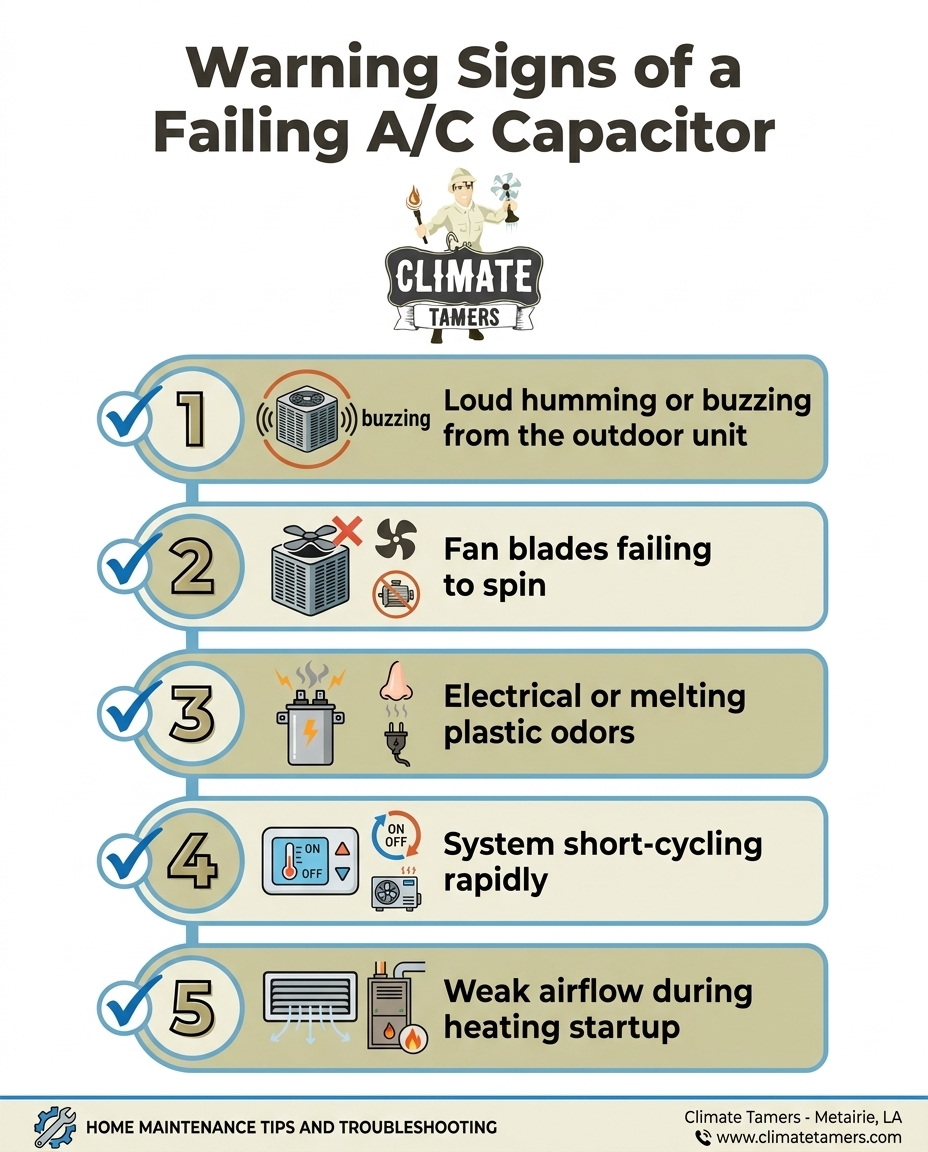
Recognizing the symptoms of a bad capacitor versus normal seasonal startup quirks can save you from a freezing night without heat. Because the capacitor is tied directly to the system's ability to start and run motors, the warning signs are usually highly noticeable if you know what to look for.
1. Loud humming or buzzing noises: If you hear a distinct, electrical humming coming from the outdoor unit, it usually means the motor is trying to start but isn't receiving the necessary voltage from the capacitor.
2. Fan blades failing to spin: You might hear the system hum, but the outdoor fan blades remain completely stationary. Some homeowners notice that if they carefully push the blades with a stick (which is not recommended), the fan starts spinning. This is a classic sign of a dead fan capacitor.
3. Weak or lukewarm airflow: If you feel weak airflow coming from the indoor vents despite the thermostat calling for heat, the compressor may not be running, meaning no heat is being generated.
4. Frequent short cycling: When a system turns on and off rapidly without completing a full heating or cooling cycle, it often points to a capacitor that cannot maintain the running voltage needed to keep the motors engaged.
One Metairie homeowner recently experienced this during the fall transition when a difficult power issue kept their system from functioning. After reaching out for help, a technician diagnosed the problem quickly, discovering that an aging capacitor—which had been struggling for weeks—finally gave out and needed replacing to restore reliable operation.
Electrical Burning Smells vs. Normal Dust
It is common to smell burning dust for a few minutes during the first heating cycle of the year. Dust settles on the heating elements or heat exchanger over the summer, and that initial startup burns it away quickly. However, an acrid, melting plastic, or electrical burning smell is never normal. Electrical odors indicate overheating components, melting wires, or a failing capacitor, and these scenarios require immediate professional attention.
Warning Signs of a Failing A/C Capacitor
The Hidden Danger: Why a Weak Capacitor Ruins Compressors
Ignoring a weak capacitor is one of the most costly mistakes a homeowner can make. When a capacitor loses its charge capacity, it cannot provide the necessary starting torque to get the compressor motor moving. This creates a mechanical crisis inside the outdoor unit.
The Problem with Hard Starts
Because the motor isn't getting the jolt it needs, it remains stationary while electricity continues to flow into it. This forces the compressor to draw significantly higher amperage to try and force itself to start. This phenomenon is known as a "hard start." The longer the motor struggles to turn over, the more electricity it pulls from the grid.
The Chain Reaction of Thermal Stress
Higher amperage leads to severe overheating and thermal stress on the compressor's internal windings. The insulation around these copper windings begins to bake and break down. If this is allowed to continue, the windings will eventually short out entirely. Prolonged hard starts caused by a $50 to $100 part will eventually cause premature, catastrophic compressor death, forcing a massive repair or a complete system replacement.
High-Voltage Risks: Why DIY Capacitor Replacement is Dangerous
With countless online tutorials available, it can be tempting to try and swap out a capacitor yourself. However, HVAC capacitors are not like standard household batteries. They store high-voltage electrical charges, often ranging between 370 and 440 volts. This makes them exceptionally hazardous to handle without proper training.
The Danger of Stored Energy
The most critical safety fact to understand is that capacitors remain extremely dangerous and can deliver a severe, potentially fatal shock even when the HVAC system is completely powered off at the breaker. The capacitor's entire job is to hold a charge, and it does not automatically empty itself just because you flipped a switch. Department of Energy safety standards emphasize that high-voltage components require specialized handling, proper discharging procedures, and specific personal protective equipment.
The Value of Professional Diagnostics
Working with licensed technicians means you are getting prompt, professional diagnostic expertise. Professionals have the specialized tools, such as insulated screwdrivers and heavy-duty multimeters, to safely handle, test, and discharge high-voltage electrical components. Furthermore, improper installation of a new capacitor—such as wiring the hermetic and fan terminals backward—can lead to electrical fires or the instant destruction of the new component, protecting neither the homeowner nor the expensive compressor.
Securing Your System with Professional Pre-Winter Diagnostics
The best way to prevent a capacitor failure on a cold Metairie night is to catch it before it happens. A comprehensive pre-winter inspection catches weakened components during the seasonal transition, ensuring your system is ready for the months ahead.
What a Professional Diagnostic Entails
During a seasonal check-up, technicians do much more than just change a filter. They use specialized multimeters to measure the exact microfarad reading of the capacitor. Every capacitor has a specific rating (for example, 45/5 microfarads). If the reading falls outside of a safe tolerance range—usually plus or minus 5%—the technician knows the part is failing, even if the system is technically still running.
Proactive Prevention
Replacing a weak part proactively prevents emergency breakdowns on the coldest nights of the year. It also stops the cascading damage that a weak capacitor inflicts on the compressor. Routine check-ups also ensure optimal indoor air quality (IAQ) by verifying that coils are clean and that the system is operating safely without electrical hazards. Enrolling in an HVAC maintenance plan is a reliable way to ensure these vital high-voltage components are tested twice a year by qualified professionals.
Ensure Reliable Heating with a Professional Assessment
Don't wait for a complete breakdown to find out your system is struggling. The transition into fall is the perfect time to evaluate your equipment's health and address the wear and tear left behind by a brutal summer. Rely on local experts to safely diagnose and resolve electrical issues before they compromise your comfort and safety.
Whether you are concerned about a strange humming noise, a lingering electrical smell, or just want the peace of mind that comes with a fully vetted system, professional oversight is essential. Schedule a professional inspection to transition into the heating season with confidence. For more insights on keeping your equipment in top shape year-round, review our complete preventative maintenance for your AC system guide and stay ahead of seasonal breakdowns.
Frequently Asked Questions
What happens when your AC capacitor goes bad?
When your AC capacitor goes bad, the system loses the electrical jolt required to start the heavy-duty motors. You will typically hear a loud humming sound from the outdoor unit, but the fan blades will not spin, and the compressor will not run. Ultimately, the system will fail to heat or cool your home, and continuing to run it can cause severe damage to the compressor.
Can a bad capacitor ruin my compressor?
Yes, a weak or failing capacitor forces the compressor to draw significantly higher electrical current to try and start. This excessive amperage causes the internal windings of the compressor to overheat rapidly. Over time, this thermal stress will burn out the compressor entirely, leading to a catastrophic and costly failure.
Why is my heat pump fan not spinning but humming?
A humming noise with a stationary fan usually indicates a failed fan-side capacitor. The motor is receiving power and trying to start, which creates the humming noise, but it lacks the stored energy from the capacitor to actually begin rotating. This requires immediate professional replacement to prevent the fan motor from burning out.
Is it safe to replace an AC capacitor yourself?
No, it is highly dangerous to replace an AC capacitor without professional training. Capacitors store high-voltage electricity (often up to 440 volts) and can deliver a severe shock even when the main power to the HVAC system is turned off. Licensed technicians use specialized tools to safely discharge and handle these components.
How do I know if the burning smell is just dust or a failing electrical part?
A brief smell of burning dust during the very first heating cycle of the year is normal and should dissipate within ten to fifteen minutes. However, if the smell resembles melting plastic, burning wires, or an acrid chemical odor, it is likely an electrical issue. If the smell persists, turn off your system immediately and call a professional.
Does a heat pump use the same capacitor for heating and cooling?
Yes, a heat pump uses the exact same dual run capacitor for both the heating and cooling cycles. Because the mechanical motors (the compressor and the outdoor fan) operate during both seasons, the capacitor is under constant demand year-round. This makes it especially vulnerable to failure during seasonal transitions.
Brad was more than helpful. He is the owner and gave us personalized service for this recent visit in 2025 as well as another visit about 4 years ago. Each time, he personally came. He and his workers were exceptional! Climate Tamers are highly recommended. They made the impossible job work.
Cathy L.
CT has provided service to me over the last year. My systems are getting older, so there have been some issues. CT has been there for me to take care of these issues in a timely manner. The customer service is top notch. I highly recommend them.
James R.
I wish we would have called CLIMATE TAMERS the FIRST time, instead of trying to chase down technicians for TWO WEEKS to service my dying A/C. There were no missed appointments, no "sorry we're running late" nonsense. They made an appointment, and kept it. Simple. Kyle, our technician, was knowledgeable, kind, professional, timely, got straight to work and fixed the problem in under an hour. Wish I could give them 100 stars
Cambre E.
While out of town my outside compressor fan stopped working. I called Climate Tamers and a technician replaced my fan motor within 2 hours of my call. I highly recommend Climate Tamers!
Joseph S.
Do yourself a favor and hire Climate Tamers , especially in this Louisiana heat I wouldn’t trust anybody else with my systems. They’ve done my service and redid all my ductwork and I’ve never had a complaint with them. Brad, Brandon, and everyone else on their team are all professionals, respectful and very reliable.
Robert L.
Responsive and helpful! They've helped us turn around a rough situation with our install and have been prompt / responsive to our outreach. I'm leaving this review for a SECOND time because we are truly impressed and thankful for the prompt service and turnaround time.
Jess A.
I want to first off say how extremely professional and knowledgeable this company is! From the first call to Climate Tamers and to the end of the service visit everything was done top notch! They came in and fixed our A/C problem immediately! I’m so thankful to know there is a reliable and knowledgeable company like Climate Tamers available for any of our A/C needs. Thanks again guys for the excellent service and getting us back running! I will definitely use you guys each time and I Highly recommend!
Mason N.
Climate Tamers was awesome. We had extensive work done including duct replacement, and an AC unit and 2 mini split systems installed. Brad and his employees were professional and conscientious, making sure everything was done as quickly as possible. Brad even brought us two window units to keep us comfortable while our AC was turned off. Everything was cleaned up at the end of each day and we never had any problems getting questions answered. I highly recommend!
Karen S.
Brad was more than helpful. He is the owner and gave us personalized service for this recent visit in 2025 as well as another visit about 4 years ago. Each time, he personally came. He and his workers were exceptional! Climate Tamers are highly recommended. They made the impossible job work.
Cathy L.
CT has provided service to me over the last year. My systems are getting older, so there have been some issues. CT has been there for me to take care of these issues in a timely manner. The customer service is top notch. I highly recommend them.
James R.
CT has provided service to me over the last year. My systems are getting older, so there have been some issues. CT has been there for me to take care of these issues in a timely manner. The customer service is top notch. I highly recommend them.
James R.
I wish we would have called CLIMATE TAMERS the FIRST time, instead of trying to chase down technicians for TWO WEEKS to service my dying A/C. There were no missed appointments, no "sorry we're running late" nonsense. They made an appointment, and kept it. Simple. Kyle, our technician, was knowledgeable, kind, professional, timely, got straight to work and fixed the problem in under an hour. Wish I could give them 100 stars
Cambre E.
While out of town my outside compressor fan stopped working. I called Climate Tamers and a technician replaced my fan motor within 2 hours of my call. I highly recommend Climate Tamers!
Joseph S.
Responsive and helpful! They've helped us turn around a rough situation with our install and have been prompt / responsive to our outreach. I'm leaving this review for a SECOND time because we are truly impressed and thankful for the prompt service and turnaround time.
Jess A.
I want to first off say how extremely professional and knowledgeable this company is! From the first call to Climate Tamers and to the end of the service visit everything was done top notch! They came in and fixed our A/C problem immediately! I’m so thankful to know there is a reliable and knowledgeable company like Climate Tamers available for any of our A/C needs. Thanks again guys for the excellent service and getting us back running! I will definitely use you guys each time and I Highly recommend!
Mason N.
Climate Tamers was awesome. We had extensive work done including duct replacement, and an AC unit and 2 mini split systems installed. Brad and his employees were professional and conscientious, making sure everything was done as quickly as possible. Brad even brought us two window units to keep us comfortable while our AC was turned off. Everything was cleaned up at the end of each day and we never had any problems getting questions answered. I highly recommend!
Karen S.
Ready to Transform Your Home?
Discover our exceptional home services tailored to meet your needs and enhance your living space.
Sed iaculis aenean sit sed risus arcu vitae integer elit.
The September Humidity Trap: Why Your House Feels Clammy When the Temperature Finally Drops
Dropping fall temperatures often leave your home feeling sticky and damp. Understand why your AC stops removing moisture and how to fix the root cause without freezing your family.
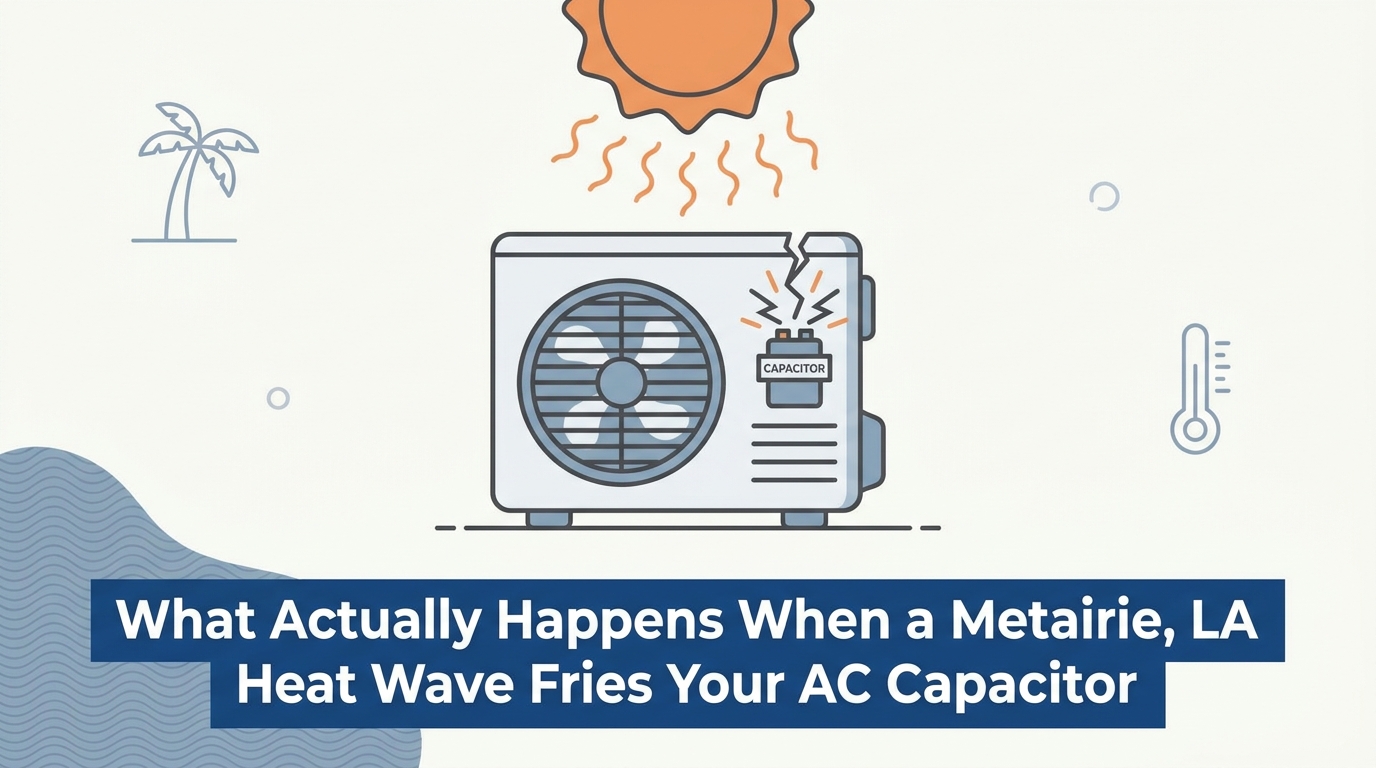
What Actually Happens When a Metairie Heat Wave Fries Your AC Capacitor
If your outside unit is humming but the fan isn't spinning, late-summer heat may have destroyed your capacitor. Find out why you must shut your system off immediately.
Understanding AC Repair: Why Cooling Systems Fail During Peak Summer Heat
Why do cooling systems fail during July heatwaves? Get clear answers on how extreme heat strains components and when it's time to call a pro for ac repair.