Heat pump defrost: steam or ice?
Steam can be normal during heat pump defrost. Learn when persistent ice, lost heating or unusual symptoms need professional attention.


You turn on your heater for the first chilly evening, expecting cozy warmth. Instead, you are met with dry, itchy skin, static shocks every time you touch a doorknob, and a scratchy throat that simply will not go away. If you are tired of waking up feeling parched, understanding exactly how furnace humidifiers work is the key to restoring your indoor comfort. When it is time to upgrade your home, reaching out to our team at Climate Tamers for professional heating services ensures your equipment operates safely and efficiently.
Winter introduces a frustrating dual challenge for homeowners. On one hand, you need to maintain a comfortable indoor humidity level to protect your health, your hardwood floors, and your wooden furniture. On the other hand, you must protect your highly sensitive HVAC system from moisture damage. In our years of preparing Metairie homes for the holidays, we have seen firsthand how a serious, concrete problem often arises: poorly integrated humidifiers.
When a whole-home humidifier is improperly installed or poorly maintained, it can leak liquid moisture directly into the heating cabinet. This constant exposure to water causes severe corrosion and eventual cracking in the furnace heat exchanger—a catastrophic failure that ruins the heater and poses severe safety risks. The decision point for homeowners is clear. You must understand how different humidifiers integrate with your system to safely add winter moisture without destroying your equipment.
The critical window for action: The November pre-winter heating season is the ideal time to address these integrations. By having our experts evaluate your system before the coldest weather hits, you ensure your home remains perfectly balanced, comfortable, and safe all winter long.
A common misconception among homeowners is that living in a region with high outdoor moisture negates the need for indoor humidification. Despite Metairie's notoriously humid summers, our technicians consistently see how running the heater during the winter months severely dries out your indoor air, making a furnace humidifier absolutely crucial for your daily comfort.
The problem: When outdoor temperatures drop, cold air holds significantly less moisture than warm air. Even if the relative humidity outside seems high, the absolute amount of water vapor in the air is quite low. When this cold air infiltrates your home and gets heated by your furnace, its relative humidity plummets.
The cause: Heating air expands its capacity to hold moisture. Because the furnace adds heat but no actual water vapor, the air becomes incredibly thirsty. It begins pulling moisture from wherever it can find it—your skin, your nasal passages, your houseplants, and your home's structural wood. Before long, our indoor air quality assessments often reveal humidity levels dropping well below the EPA's recommended 30 to 50 percent range, sometimes falling as low as 15 percent.
The solution: To counteract this intense drying effect, you need reliable indoor air quality solutions that proactively introduce water vapor back into the airflow. Addressing this extreme dryness during the November pre-winter heating season reduces the strain placed on both your household comfort and your heating equipment. When the air is properly humidified, it actually feels warmer to your skin, allowing you to lower your thermostat slightly and reduce the overall workload on your furnace.
To safely combat dry indoor air, whole-home humidifiers rely on a precise mechanical process that operates in tandem with your existing heating equipment. Unlike portable room humidifiers that require constant refilling and only treat a small area, a whole-home system treats every cubic foot of air that passes through your ductwork.
If you plan to install humidifier in furnace setups, it is vital to understand that the goal is balanced vapor distribution without ever allowing liquid water to pool inside the HVAC cabinet. Here is the step-by-step breakdown of how these systems function:
1. Monitoring the air: A device called a hygrostat (or humidistat) is mounted on your return air duct or integrated into your smart thermostat. It constantly measures the moisture levels in your home.
2. Calling for moisture: When the indoor humidity drops below your set preference, the hygrostat sends an electrical signal to the humidifier's water valve.
3. Releasing the water: The valve opens, allowing a metered amount of water from your home's plumbing supply to flow into the humidifier's distribution tray.
4. Vaporizing the moisture: The warm air generated by the furnace passes through the humidifier, evaporating the water and carrying it as a fine vapor directly into your living spaces.
At the center of this mechanical process sits the water panel, also known as an evaporator pad. This component acts as the primary distribution medium. As water trickles down from the distribution tray, it saturates the porous, honeycomb-like structure of the panel. When the warm furnace air blows across this expanded surface area, the water rapidly evaporates into the airstream.
Our maintenance crews always emphasize that regular replacement of the water panel is absolutely essential for the system to function correctly. Over time, the minerals naturally present in your water supply are left behind during the evaporation process. This mineral scale builds up on the panel, restricting airflow and preventing proper water absorption. A heavily scaled water panel not only stops humidifying your home but can also cause incoming water to back up, overflow the tray, and leak down into the furnace cabinet.
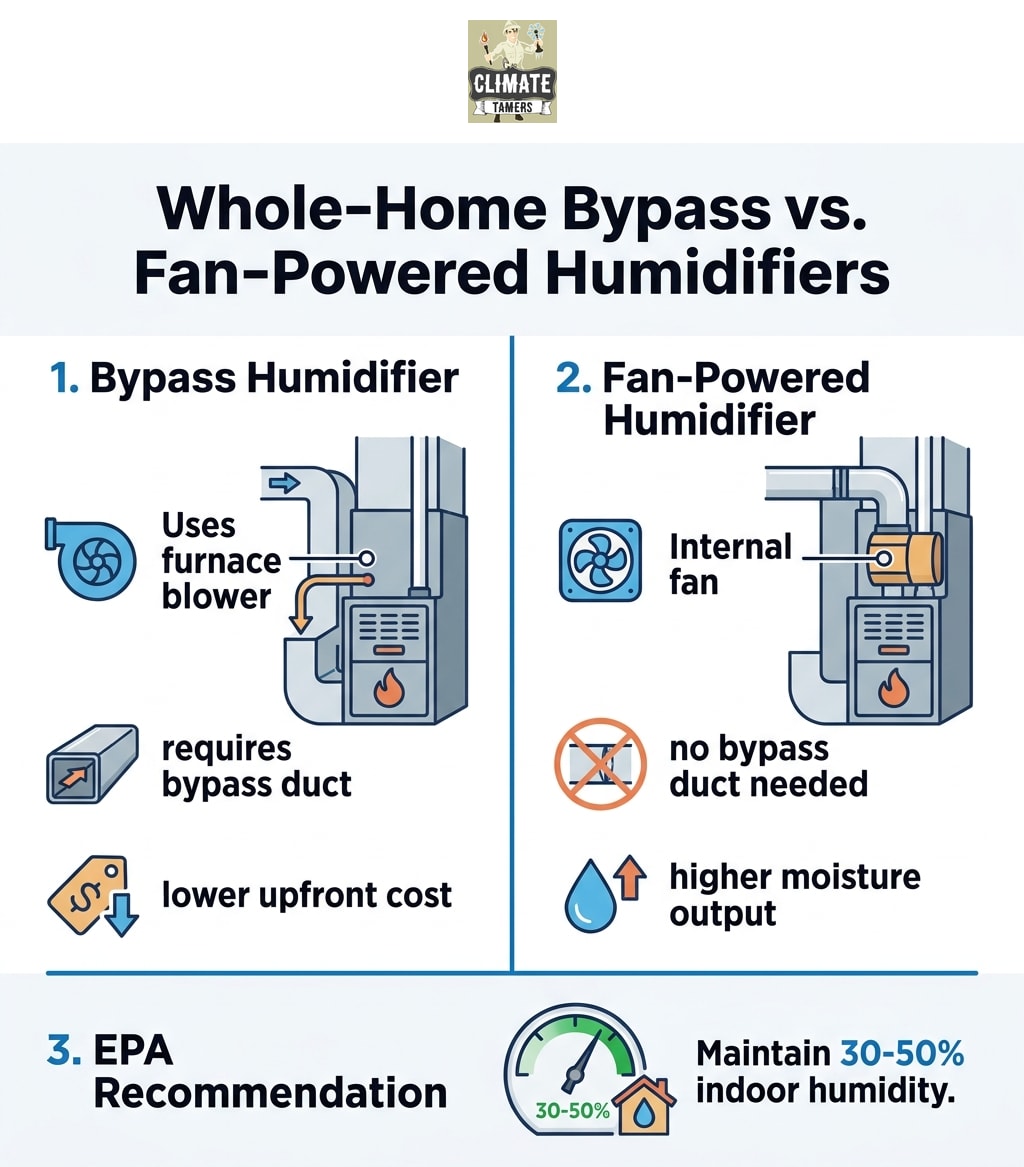
When selecting a system for your home, you will generally choose between two primary designs: whole-home bypass vs. fan-powered humidifiers. Both utilize a water panel to evaporate moisture, but their mechanical integration with your ductwork differs significantly.
A whole-home bypass humidifier relies entirely on the furnace's internal blower motor to move air. It is typically mounted on the return or supply plenum, with a dedicated bypass duct connecting the two sides of the system. When the furnace runs, the pressure difference between the supply and return forces warm air through the bypass duct, across the water panel, and back into the airflow.
A fan-powered humidifier operates differently. Instead of relying on a bypass duct and the furnace's pressure differential, this unit features its own internal fan. It pulls hot air directly from the furnace plenum, blows it forcefully across the saturated water panel, and pushes the newly humidified air straight into the ductwork. Because they generate their own airflow, fan-powered models generally offer a higher daily moisture output.
If you are considering installing a whole-house humidifier, our Climate Tamers team can help review your structural differences to determine which model fits your specific mechanical room.
• Airflow Source — Whole-Home Bypass Humidifier: Furnace blower motor — Fan-Powered Humidifier: Internal built-in fan
• Space Requirements — Whole-Home Bypass Humidifier: Requires extra space for a bypass duct — Fan-Powered Humidifier: Compact; mounts directly to the plenum
• Moisture Output — Whole-Home Bypass Humidifier: Moderate (excellent for average homes) — Fan-Powered Humidifier: High (ideal for larger or very dry homes)
• Energy Efficiency — Whole-Home Bypass Humidifier: Uses no additional electricity — Fan-Powered Humidifier: Uses a small amount of electricity for the fan
• Integration Impact — Whole-Home Bypass Humidifier: Relies on furnace pressure differential — Fan-Powered Humidifier: Operates independently of duct pressure
While the benefits of balanced indoor humidity are immense, the mechanical relationship between your humidifier and your furnace requires absolute precision. When a humidifier is improperly mounted, poorly leveled, or neglected during routine maintenance, the risk of catastrophic equipment failure skyrockets. The most severe danger is a cracked heat exchanger.
The problem: A leaking humidifier allows liquid water to drip directly into the furnace cabinet. This usually happens because a DIY installer failed to level the unit, the drain line became clogged, or the water pressure was set too high.
The cause: Inside your furnace sits the heat exchanger—a series of metal tubes or coils that safely separate the toxic combustion gases of the burner from the clean air blowing into your home. When constant moisture from a leaking humidifier drips onto this hot metal, it causes rapid oxidation. The metal begins to rust, thin out, and weaken. Through the continuous expansion and contraction of heating cycles, that weakened, rusted metal eventually cracks.
The solution: Preventing this mechanical disaster requires proactive professional oversight. In our real-world field experience at Climate Tamers diagnosing complex heating failures across Metairie, we frequently find that severely rusted or cracked heat exchangers trace directly back to a neglected humidifier leak. We look beyond the surface symptoms—like a furnace shutting down prematurely—to find the root cause of the moisture. According to safety data from CPSC.gov, a cracked heat exchanger is a severe hazard because it can allow dangerous carbon monoxide to enter the living space.
To protect your home, use the November pre-winter heating season to schedule a comprehensive evaluation. Enrolling in a professional HVAC maintenance plan ensures that both your humidifier and your heat exchanger are thoroughly inspected for early signs of corrosion before heavy winter usage begins.
Given the severe risks associated with water leaks and heat exchanger damage, integrating a whole-home humidifier is never a weekend DIY project. The precision required to safely combine water, electricity, and forced-air heating demands specialized training and professional tools.
The process of installing humidifier on furnace equipment requires cutting exact openings into the sheet metal of your supply or return plenums. If these cuts are improperly sized or the mounting bracket is not perfectly leveled, the unit will leak. Furthermore, our professional installers know how to safely tap into your home's hot or cold water lines to supply the unit, utilizing proper saddle valves or dedicated shut-off valves to prevent plumbing disasters.
Professional calibration is equally critical:
• Electrical integration: The hygrostat must be correctly wired into the furnace control board so that the humidifier only operates when the blower motor is running. If wired incorrectly, the humidifier could dump water into the ductwork while the fan is off, causing massive pooling.
• Moisture calibration: Our technicians calibrate the hygrostat to ensure the system does not over-humidify the space. Pushing too much moisture into cold ductwork leads to condensation buildup, which fosters mold growth inside the vents.
• Drainage routing: Flow-through humidifiers require a dedicated drain line to carry away excess water. Professionals ensure this line is properly sloped and routed to a floor drain or condensate pump to prevent basement flooding.
Ultimately, proper installation is about protecting your expensive furnace infrastructure just as much as it is about improving your indoor comfort. Trusting our residential HVAC services guarantees that your new humidifier operates flawlessly without putting your heat exchanger at risk.
A whole-home humidifier attaches directly to the sheet metal ductwork of your furnace, typically on the supply or return air plenum. Safe mechanical integration requires cutting a precise hole in the ductwork, mounting the unit perfectly level to prevent leaks, and connecting a dedicated water supply line. Depending on the model, a bypass duct may also be installed to route air from the supply side, through the humidifier's water panel, and back into the return airflow.
Yes, if a humidifier is improperly installed or poorly maintained, it can cause catastrophic damage to a furnace. The primary risk occurs when a unit leaks liquid water into the furnace cabinet, which causes the metal heat exchanger to rust, weaken, and eventually crack. Regular professional maintenance and correct initial installation are essential to prevent moisture from destroying the internal heating components.
Yes, whole-home furnace humidifiers are highly effective at raising indoor moisture levels throughout the entire house. Because they integrate directly with the HVAC blower, they distribute water vapor evenly into every room connected to the ductwork. This provides a much more consistent and balanced comfort level compared to portable room humidifiers.
No, a properly installed furnace humidifier only runs when two specific conditions are met simultaneously. First, the hygrostat must detect that the indoor humidity has dropped below your desired setpoint. Second, the furnace blower motor must be actively running to distribute the vapor. If the blower is off, the humidifier remains off to prevent water from pooling inside the stationary ductwork.
The EPA recommends maintaining your indoor relative humidity between 30 and 50 percent during the winter months. Staying within this range prevents the health and comfort issues associated with dry air, such as static shocks and dry skin. It also protects your home from the risks of over-humidification, which can lead to condensation on cold windows and potential mold growth.
A clear understanding of how furnace humidifiers operate empowers you to make safe, effective choices for your home's indoor air quality. Whether you choose a whole-home bypass vs. fan-powered humidifiers, the mechanics remain focused on introducing balanced, controlled moisture into your living space. Most importantly, relying on professional installation prevents catastrophic damage, ensuring your heat exchanger remains completely protected from rust and cracking.
Do not wait until the coldest days of the year to realize your indoor air is uncomfortably dry. Our team at Climate Tamers highly encourages you to use the November pre-winter heating season to evaluate your indoor air quality needs safely. By acting proactively, you can secure a warm, perfectly balanced, and comfortable home environment long before the freezing weather arrives.

Our customers consistently praise Climate Tamers for our professionalism, fast service, and commitment to keeping their homes comfortable.